
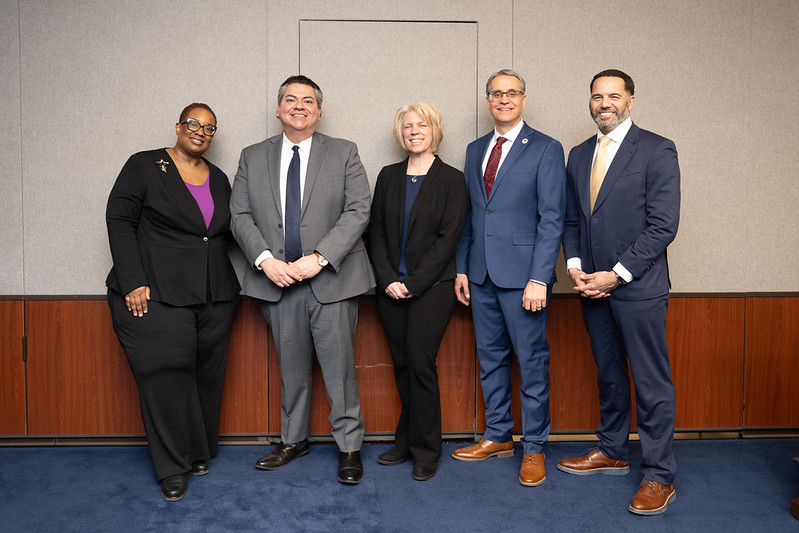

On Wednesday, February 11, the Council for Opportunity in Education (COE) hosted a special lunch briefing on Capitol Hill to mark the 40th anniversary of National TRIO Day. Held in the Rayburn House Office Building, the event brought together Members of Congress, congressional staff, TRIO professionals, and TRIO alumni to celebrate over six decades of expanding educational opportunity and to reaffirm why TRIO remains essential to the nation’s future.
As COE President Kimberly Jones reminded attendees, National TRIO Day was established in 1986 through House Concurrent Resolution 278 in response to proposed across-the-board cuts to domestic programs, including TRIO. Since then, the fourth Saturday in February has become a nationwide celebration of TRIO’s achievements and the more than six million college graduates the programs have helped produce.
Congressional TRIO Caucus Co-Chairs Congresswoman Gwen Moore and Congressman Mike Simpson underscored TRIO’s enduring bipartisan support. Both emphasized that TRIO works and that education remains the most powerful strategy to end poverty and strengthen communities.
As Congressman Simpson noted, “If you want to end poverty in this country, education is the way you go.”
But the luncheon was more than a commemoration. It was a living testament to TRIO’s impact, told through the voices of alumni who now serve as leaders in business, science, and public service.
How TRIO Never Gave Up
Victor Burrola, Executive Director and Senior Lead Community Impact and Sustainability Specialist at Wells Fargo, opened the alumni panel by grounding the conversation in personal experience. A first-generation college graduate and son of migrant workers from Greeley, Colorado, Victor credited Upward Bound with transforming what once felt like an unattainable dream into a clear and achievable pathway.
Thanks to three summers on the Colorado State University (CSU)’s Upward Bound program, Victor gained not only academic preparation but also a roadmap to college success. When family challenges later derailed his academic progress—resulting in his dismissal from the university—it was his Upward Bound mentors who stepped in with encouragement, accountability, and a plan to get him back on track.
“They never gave up on me,” Victor shared. “TRIO never gave up on me. And we should never give up on TRIO.” Through the encouragement and support of his TRIO mentors, Victor re-enrolled in college and ultimately earned a master’s degree in public administration.
Today, Victor leads community impact efforts across the Washington metropolitan area, directing philanthropic investments in historically marginalized communities. Around his own kitchen table, conversations about higher education and professional success are now the expectation, not the exception, and demonstrate the multigenerational ripple effect of TRIO’s investment.
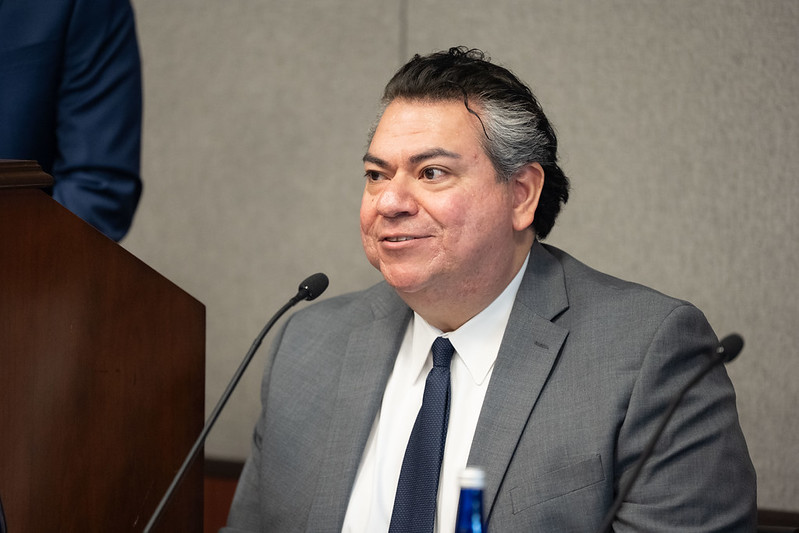
Alumnus, TRIO Upward Bound, Colorado State University
TRIO Is the American Dream in Policy Form
Best-selling author and Seramount Managing Director Steve Pemberton offered a broader historical lens. Referencing historian James Truslow Adams’ 1931 definition of the American Dream as opportunity “according to ability or achievement,” Steve described TRIO as “the American Dream, but in policy form.”
He emphasized that the American Dream is not self-executing. It requires structures, ramps, elevators, advising, tutoring, proximity, and belief. That is precisely what TRIO provides.
Steve also framed TRIO as more than a social program. It is, he argued, a workforce development engine. Department of Education evaluations show that TRIO participants are significantly more likely to earn bachelor’s degrees or complete credentials, outcomes that translate into higher lifetime earnings and a strengthened tax base. Investing in TRIO is not charity, he declared; it is a strategic investment in national productivity.
It was Pemberton’s deep personal story that moved the room most profoundly. A third-generation orphan who endured trauma in the foster care system, Steve described TRIO Upward Bound counselors as “lighthouses” who intervened at pivotal moments. One counselor even opened his home to him after Steve fled an abusive foster placement.
“If you want to know what TRIO is,” he said, “it answers the call. And in doing so, it doesn’t just change individuals’ lives. It ends cycles.”
The opportunities afforded by TRIO allowed Steve to go on to earn both his bachelor’s and master’s degrees in sociology and emerge as a senior executive and human capital strategist at several multinational corporations.

Alumnus, TRIO Upward Bound, University of Massachusetts-Dartmout
Wasting Potential Is National Disservice
Tara Ruttley, Chief Scientist for Orbital Reef at Blue Origin, spoke to the national implications of investing in talent that might otherwise go unseen. Raised in southern Louisiana by a single mother, Tara dreamed of working for NASA but had no roadmap to get there.
After dropping out of college due to financial strain and working multiple jobs, she transferred to Colorado State University. A rejection from a NASA internship led her, almost by accident, to TRIO’s Ronald E. McNair Postbaccalaureate Achievement Program. That decision changed everything.
McNair replaced guesswork with preparation. Tara learned how to design research projects, pursue graduate funding, navigate the GRE, and, perhaps most importantly, believe she belonged in scientific spaces. This renewed confidence led Tara to earn four degrees, including a doctorate in neuroscience.
She would go on to fulfill her dreams through a 21 year career at NASA, serving as associate chief scientist and managing research aboard the International Space Station, before transitioning to help build a commercial low-Earth-orbit economy at Blue Origin.
“Wasting potential is a national disservice,” Tara stated plainly. TRIO’s impact cannot be measured solely in resumes or data points, she shared; it is reflected in strengthened families, communities, industries, and national capacity.
The briefing was moderated by COE Executive Vice President, Aaron Brown, who also shared part of his own TRIO story. Raised in a challenging family environment in rural Washington State, Aaron experienced academic challenges very early on in his formative years. As college was seemingly out of reach, Aaron found himself working retail following high school graduation. Ultimately, he decided to give community college a try and, through the help of TRIO Student Support Services, earned not only his associate’s and bachelor’s degrees, but later completed a doctorate in public affairs. He then dedicated his career to serving students from similar backgrounds at various institutions of higher education before joining the Council.
Throughout the briefing, one theme resonated clearly: TRIO does more than help students access higher education. It converts raw talent into national strength. It transforms aspiration into achievement. It reshapes family trajectories and strengthens the workforce.

Forty years after National TRIO Day was established in response to funding threats, the message remains urgent and timeless. TRIO is not simply a program. It is a strategic federal investment in America’s talent pipeline, an investment that continues to yield leaders in finance, human capital, science, engineering, public service, and beyond.
As the panelists’ stories demonstrated, TRIO’s greatest impact is not abstract. It is personal, generational, and national.
And, after more than 60 years, TRIO’s impact continues. View more photos from the briefing here.